
- MOQ 1 piece — prototype, short run, or production from the same floor.
- ±0.003 mm milling and turning; ±0.002 mm grinding, on Hexagon CMMs.
- Aluminum, stainless, brass, copper, titanium, magnesium, plastics — XRF-verified at intake.
- 3 / 7 / 30-day lead times by complexity; complex parts run 10–20 steps.
1. What determines the unit cost of a machined part?
Every machined part's price is the sum of four things, and the quantity you order decides which of the four dominates. There is the one-time engineering — programming, tool selection, and workholding design. There is the material, which scales roughly linearly with the number of parts. There is the machine time, which depends on how efficiently the process is set up. And there is the inspection, which can be as heavy as a full first-article on a prototype or as light as a sampled dimension on a stable production run.
The reason two parts of identical geometry can carry wildly different prices is that these four costs respond differently to quantity. A buyer who understands which cost is dominant at their order size can talk to a manufacturer about the right levers — a material substitution, a tolerance relaxation, a fixture — instead of simply accepting a number.
2. Which part families stay affordable at low volume?
Some parts are naturally cheap even at one piece, and they share a common feature: almost all of their cost is recurring, not one-time. A simple turned pin, a spacer, a bracket with a few holes — these need a short program, a standard tool, and a general-purpose workholding, so the setup cost is small and the per-part cost is mostly metal and machine time.
| Part family | Why it is affordable at low volume | Typical process |
|---|---|---|
| Pins, shafts, spacers | Single setup, standard tools, short program | CNC turning |
| Simple brackets and plates | Few features, open tolerances, fast cycle | 3-axis milling |
| Bushings and sleeves | Round geometry, one clamping, easy to check | Turning + grinding |
These parts are the backbone of low-volume work, and they are also the parts where a manufacturer's discipline matters most, because there is nowhere to hide: a simple part that measures wrong has no complexity to blame it on.
3. Which part families only get cheap at volume?
At the other end are the parts that are expensive to set up but cheap to repeat. A housing with a dozen machined faces, a manifold with cross-drilled ports, a bracket that needs five-axis positioning on three sides — these parts carry a heavy one-time cost in programming and fixturing. Ordered as one-offs, they are expensive. Ordered in production, that one-time cost spreads thin, and the recurring cost drops further when the process moves to a single-setup multi-axis path or a dedicated fixture.
The signature of this family is a large gap between the prototype price and the production price. That gap is not a supplier inflating the prototype — it is the honest difference between building a process and running one. The buyer's job is to make sure the production price actually reflects that process being built, rather than the supplier quietly re-charging setup at every quantity tier.
4. How does material choice interact with quantity?
Material is the one cost that scales almost linearly with quantity, which means it is also the one cost where a small per-part change pays off most at volume. Saving a fraction on raw stock is irrelevant on a five-piece order and meaningful on a fifty-thousand-piece one. The material family also changes how fast and how reliably the part machines, which feeds back into both machine time and scrap.
This factory machines aluminum, stainless steel, brass, copper, titanium, and magnesium, plus engineering plastics. Aluminum is forgiving and fast, which keeps both machine time and tool wear low. Stainless steel cuts hotter and wears tools faster, so the same part in stainless carries a higher recurring cost. Titanium is slower still and more demanding on tooling. The point is not that one material is better — it is that the material and the quantity are a single decision, and the economically right material at prototype quantity is sometimes not the right one at production quantity.
5. How does tolerance drive both cost and quantity?
Tolerance is the steepest cost lever in machining, and it interacts with quantity in a specific way. A tight tolerance costs money at every quantity — it means slower feeds, more careful fixturing, temperature awareness, and more inspection — but it costs disproportionately more at low volume, because you pay for all that discipline on a handful of parts with no amortization.
The discipline that keeps tolerance affordable is selectivity. Tolerance the two or three features that control function, and leave the rest at a comfortable general tolerance. A part with two bearing bores at a tight tolerance and every other surface relaxed costs a fraction of the same part toleranced tight everywhere, and the loose surfaces perform no differently for it. Ask the manufacturer which callouts are driving your price and what relaxing each one saves; that answer, given in numbers, is the difference between a vendor and a partner.
6. When does design-for-volume pay off?
Design-for-volume is the practice of changing a part slightly so that it becomes cheaper to make in quantity, and it is where the largest savings often hide, because a small change in the model can remove an entire operation. A chamfer that eliminates a deburring step, a radius that lets a standard cutter reach a pocket, a hole pattern that lets one fixture hold the part in a single clamping: none of these changes the part's function, and all of them change its production cost.
The right time for a design-for-volume pass is after the prototype proves the function and before the production run is locked. At that point the manufacturer has seen the part, understands where the process is inefficient, and can propose changes with dollar figures attached. A manufacturer who only ever quotes the drawing as-is is leaving money on the table that a design-aware one would hand back to you.
7. What equipment sits behind low- and high-volume parts?
The equipment ladder mirrors the quantity ladder. For prototypes and small batches, flexible machines — 3-axis milling centers and standard lathes — do the job, because flexibility is what a one-off needs and speed is not yet the bottleneck. For production, the floor moves up the ladder: 4- and 5-axis centers and mill-turn machines finish complex parts in one clamping, Swiss-type lathes feed bar stock through long runs, and dedicated fixtures multiply parts per setup.

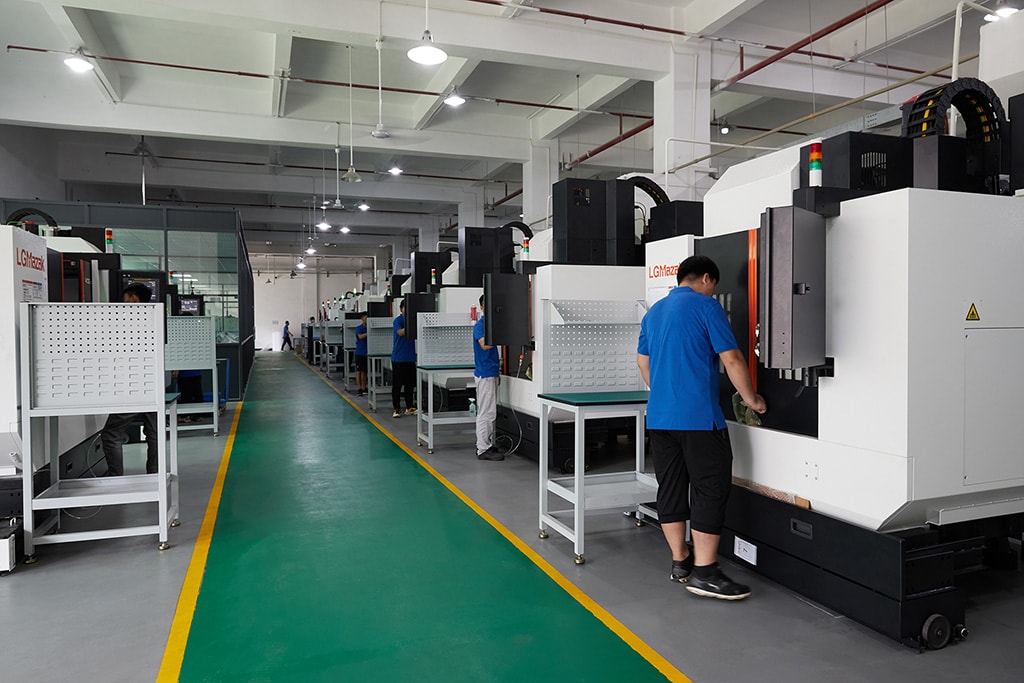
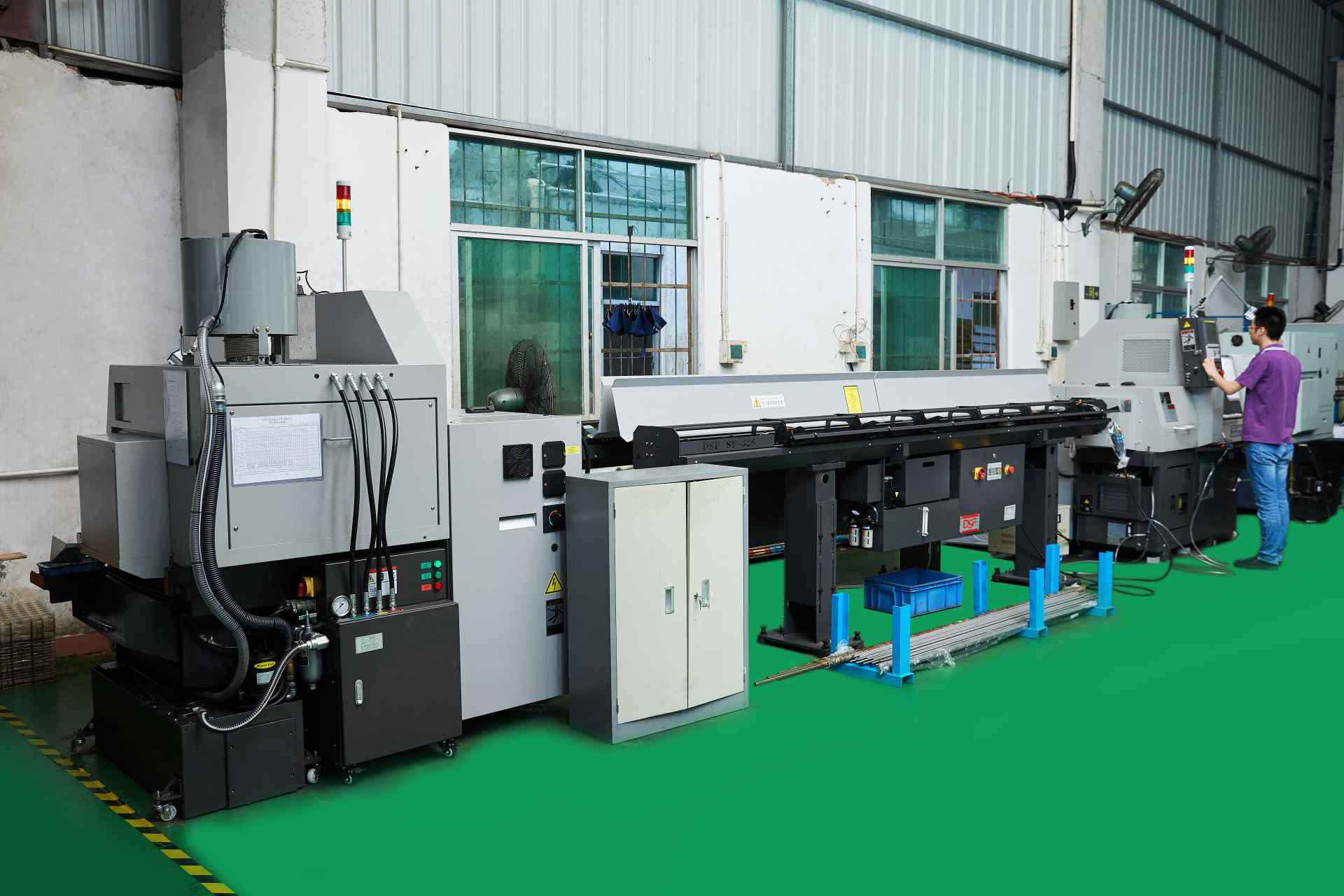
The manufacturer's job is to route your part to the right rung, not to sell you the most expensive machine on the floor, but to match the machine to your quantity so the unit price is the lowest it can honestly be.
8. Which material suits which part family?
Material choice is not a spec on a drawing — it is a decision about what the part is for, and it should be made together with the part family. A structural housing and a threaded pneumatic fitting are different families, and the material that is cheap in one is wasteful in the other. The table below pairs the common alloys with the part families they serve, so the material and the part are chosen as one decision rather than two.
| Material | Typical part family | Why the pairing works |
|---|---|---|
| 6061-T6 aluminum | Housings, brackets, plates, fixtures | Light, fast to cut, low material cost at any quantity |
| 7075-T6 aluminum | High-stress structural parts | Strength approaching steel at a fraction of the weight |
| 304 stainless steel | Food, fluid, and general corrosion parts | Corrosion resistance where aluminum fails |
| 316 stainless steel | Marine, chemical, and medical parts | Chloride resistance beyond 304 |
| 360 brass | Fittings, connectors, small threaded parts | Easiest metal to cut, fine threads hold well |
| C110 copper | Bus bars, heat sinks, electrodes | Conductivity that aluminum cannot match |
| Ti-6Al-4V titanium | Aerospace and implant parts | Strength-to-weight and biocompatibility |
| POM / PEEK | Insulators, wear pads, light structural parts | Electrical isolation and low friction |
The quantity dimension returns here too. A part family that runs in production can absorb a more expensive alloy because the material cost is planned across thousands of units; a prototype should usually start in the cheapest alloy that proves the geometry, then move to the production alloy once the design is frozen. Choosing the material and the quantity as one decision is what keeps a buyer from paying production-grade material on a prototype that may still change.
9. How do you classify a part's complexity before quoting?
Complexity is not a feeling — it is three countable things, and naming them before you quote a part lets you predict which shape its cost curve will take. The three are feature count, tolerance tightness, and secondary processes. A part with three simple features, standard tolerances, and no finishing is a simple part whose cost is mostly material and machine time. A part with a dozen faces, two tight bores, and an anodize step is a complex part whose cost is mostly the one-time process built around it.
- Feature count. Count the machined features — holes, pockets, threads, faces. Every feature is a tool and a toolpath; a part with thirty features carries thirty chances for setup and inspection cost.
- Tolerance tightness. Count how many dimensions call tighter than a general grade. Two or three tight callouts are affordable; twenty tight callouts are a grinding program wearing a milling part's clothes.
- Secondary processes. Count the steps after the chip is cut — anodize, plate, heat treat, grind. Each one adds a queue, a minimum batch, and a cost curve of its own.
The classification pays off because it predicts the curve. A low-feature, loose-tolerance, no-finish part has a flat curve — it is cheap at one piece and only a little cheaper at a thousand. A high-feature, tight-tolerance, multi-finish part has a steep curve — expensive as a prototype, cheap only in production. Knowing which class your part sits in tells you where the price should move as quantity rises, and whether a supplier's quote is following the part's real economics or ignoring them.
Frequently Asked Questions
Which machined parts are affordable at low volume?
Simple prismatic parts and turned round parts with few operations and standard tolerances stay affordable at low volume, because their setup cost is small and most of the price is straightforward machine time and material.
Which machined parts only get cheap at production volume?
Parts with multiple setups, tight tolerances, or several secondary processes only get cheap at volume, because that is where dedicated fixtures, multi-axis single-setup machining, and automated bar feeding can amortize their one-time cost.
What is the MOQ for CNC machined parts?
The MOQ is 1 piece. A single prototype, a short validation run, or a production batch can all be ordered, so you can qualify a design before committing to volume.
What tolerances are held on machined parts?
Milling and turning hold ±0.003 mm, and precision grinding holds ±0.002 mm. Critical dimensions are verified on Hexagon CMMs with process capability Ppk ≥ 1.67 at the initial study on key characteristics and Cpk ≥ 1.33 on general characteristics. Capability is reported per characteristic: every report names the feature, its tolerance band, the sample size, the sigma method, and the study window.
Which materials can be machined?
Aluminum, stainless steel, brass, copper, titanium, and magnesium, plus engineering plastics. Incoming material is verified by XRF against the mill certificate before any machining begins.
What are the lead times for machined parts?
Lead times are roughly 3, 7, or 30 days depending on part complexity and process steps. Complex parts run 10 to 20 steps, and surface finishing moves a part into the longer tier.
How do I get a quote for machined parts?
Send your STEP model or 2D drawing to [email protected] with your target quantities. You receive a design-for-manufacturing review and a quantity-break quote, usually within one business day.
Which material suits which part family?
Material and part family are one decision. Aluminum suits housings and brackets, stainless steel suits corrosion parts, brass suits small threaded fittings, copper suits conductive parts, and titanium suits aerospace and implant parts. A prototype should start in the cheapest alloy that proves the geometry, then move to the production alloy once the design is frozen.
How do I classify my part's complexity?
Count three things: machined features, tight-tolerance callouts, and secondary processes. Few features with standard tolerances and no finishing make a simple part whose cost is mostly material and machine time; many features, tight bores, and finishing steps make a complex part whose cost is mostly the one-time process built around it.
Ready to see your part's cost at your quantity?
Send your drawing to [email protected] or call +86 13126536955 for a quantity-break quote and DFM review.